
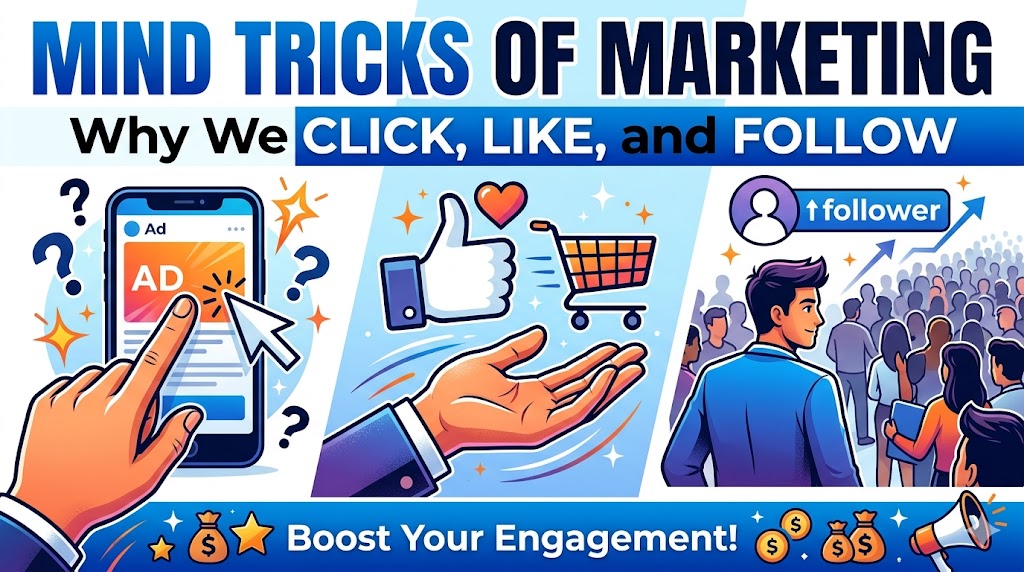
Ever wondered why you click on certain ads without thinking, like posts instantly, or follow a brand you just discovered? It’s not random. Behind every scroll-stopping post and irresistible offer lies a set of psychological triggers that marketers carefully use to influence behavior.
Welcome to the fascinating world of marketing psychology—where human emotions, biases, and decision-making patterns shape what we buy, like, and trust.
The Psychology Behind Every Click
Humans like to believe we make rational decisions, but most of our online behavior is driven by subconscious cues. Marketers understand this and design content that appeals to our instincts rather than logic.
From colors and words to timing and social proof, every detail is intentional.
1. The Power of Curiosity
Ever clicked on a headline that says, “You won’t believe what happened next”?
That’s curiosity at work.
When there’s a gap between what we know and what we want to know, our brain pushes us to close that gap. Marketers use this by crafting intriguing headlines, teaser content, and mystery-driven ads.
👉 Result: More clicks, more engagement.
2. Emotional Triggers Drive Action
People don’t buy products—they buy feelings.
Whether it’s happiness, fear, nostalgia, or excitement, emotions play a huge role in decision-making. A heartwarming story or a fear-based message (“limited time offer”) can push users to act immediately.
👉 Result: Stronger connection and higher conversions.
3. Social Proof: Following the Crowd
Why do we trust products with thousands of reviews?
Because if others are doing it, it must be right.
This is called social proof. Testimonials, influencer endorsements, ratings, and user-generated content all create a sense of trust and credibility.
👉 Result: Increased trust and faster decision-making.
4. Scarcity & Urgency
“Only 2 items left!”
“Offer ends tonight!”
These messages trigger fear of missing out (FOMO). When something seems limited, its perceived value increases.
👉 Result: Quick decisions and impulse actions.
5. Visual Appeal & First Impressions
We process visuals faster than text.
Colors, fonts, and design can influence how we feel about a brand within seconds. For example:
- Red creates urgency
- Blue builds trust
- Minimal design signals professionalism
👉 Result: Better engagement and brand perception.
6. The Reciprocity Principle
When someone gives us something valuable for free, we feel the need to give back.
Free eBooks, templates, or trials create a psychological obligation in users, making them more likely to convert later.
👉 Result: Higher chances of customer loyalty.
7. The Need for Belonging
Humans love being part of a community.
Brands that create a strong identity—through storytelling, values, or culture—make users feel connected. When people relate to a brand, they don’t just follow—they advocate.
👉 Result: Loyal audience and organic growth.
Why We Like & Follow
Putting it all together, we:
- Click because we’re curious
- Like because we feel something
- Follow because we trust and relate
Marketing works best when it feels natural—not like selling, but like storytelling and connection.
Final Thoughts
Marketing today isn’t just about promoting products—it’s about understanding people.
The more a brand taps into human psychology, the more powerful its impact becomes. So next time you click on an ad or follow a page, take a second to think—what triggered you?
Chances are, it wasn’t an accident.
Bonus Tip for Marketers
If you want to stand out:
- Focus on emotions over features
- Build trust before selling
- Create value consistently
- Speak like a human, not a brand
Because in the end, marketing isn’t about algorithms—it’s about people.